
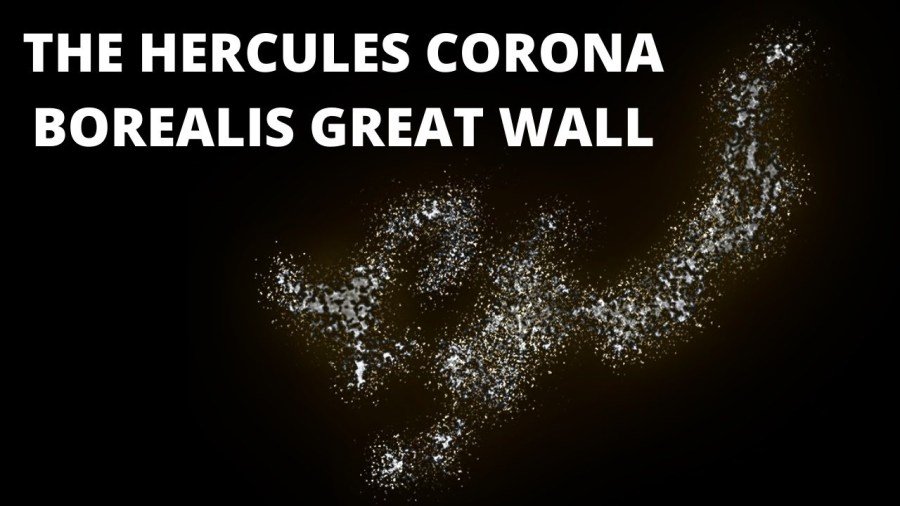
April 24, 2025 — ASTRONOMY & SPACE SCIENCE — A newly published study has significantly altered our understanding of one of the largest known structures in the universe — the Hercules–Corona Borealis Great Wall. Astronomers now report that this colossal cosmic formation is not only larger than earlier estimates but also closer to Earth than previously believed, shaking up long-held assumptions about the universe’s structure and its rate of evolution.
Gamma-Ray Bursts Offer a Clearer Cosmic Map
The updated findings come from researchers John Hakkila and Zsolt Bagoly, who analyzed a broader set of gamma-ray bursts (GRBs) — powerful, bright flashes from collapsing stars or neutron star collisions — to trace distant galactic activity. These GRBs act as cosmic lighthouses, helping to pinpoint clusters of galaxies billions of light-years away.

The study reveals that many previously catalogued GRBs align with a more extensive and wider structure than was first proposed when the Great Wall was discovered in 2014. “The number of relatively nearby GRBs suggests the structure is not only vast, but also closer than assumed,” said Hakkila, underscoring the implications for cosmological theory.
A Structure That Defies the Cosmological Principle
Spanning over 10 billion light-years, the Hercules–Corona Borealis Great Wall defies the “cosmological principle” — the idea that, on a large enough scale, the universe is uniform and isotropic. The discovery that the structure is larger and more detailed than expected implies that the early universe may have formed massive structures more quickly than current models can explain.
Such large-scale anomalies challenge standard theories of cosmic inflation and galaxy formation, potentially pointing to new physics or previously unconsidered mechanisms in the early universe.
Upcoming ESA Mission THESEUS to Expand the GRB Map
While NASA’s Fermi satellite has detected over 500 GRB events, the sample remains limited. Future data will be crucial to verify the full extent and shape of the Great Wall. Enter THESEUS — the Transient High Energy Sources and Early Universe Surveyor, a mission by the European Space Agency scheduled for launch later this decade.

Hakkila emphasized THESEUS’s potential, stating: “This mission could finally give us the observational reach needed to truly map out the Great Wall and see just how far it stretches. It will refine our grasp of the universe’s architecture.”
Author Profile

- My name is Ganpat Singh Choughan. I am an experienced content writer with 7 years of expertise in the field. Currently, I contribute to Daily Kiran, creating engaging and informative content across a variety of categories including technology, health, travel, education, and automobiles. My goal is to deliver accurate, insightful, and captivating information through my words to help readers stay informed and empowered.
Latest entries
 HEADLINESMarch 31, 2026BJP Womens Wing Announces New 48-Member Team to Strengthen Organization
 HEADLINESMarch 31, 2026Gurjar Reservation Committee Holds Critical Meeting, Warns Government of Intensified Protests
 HEADLINESMarch 31, 2026RSS Leader Advocates for Larger Families and Organizational Changes in Rajasthan
 HEADLINESMarch 31, 2026Congress Appoints 13 Municipal Presidents in Rajasthan to Strengthen Organization