Major Changes Proposed for Dairy Cooperative Elections in Rajasthan
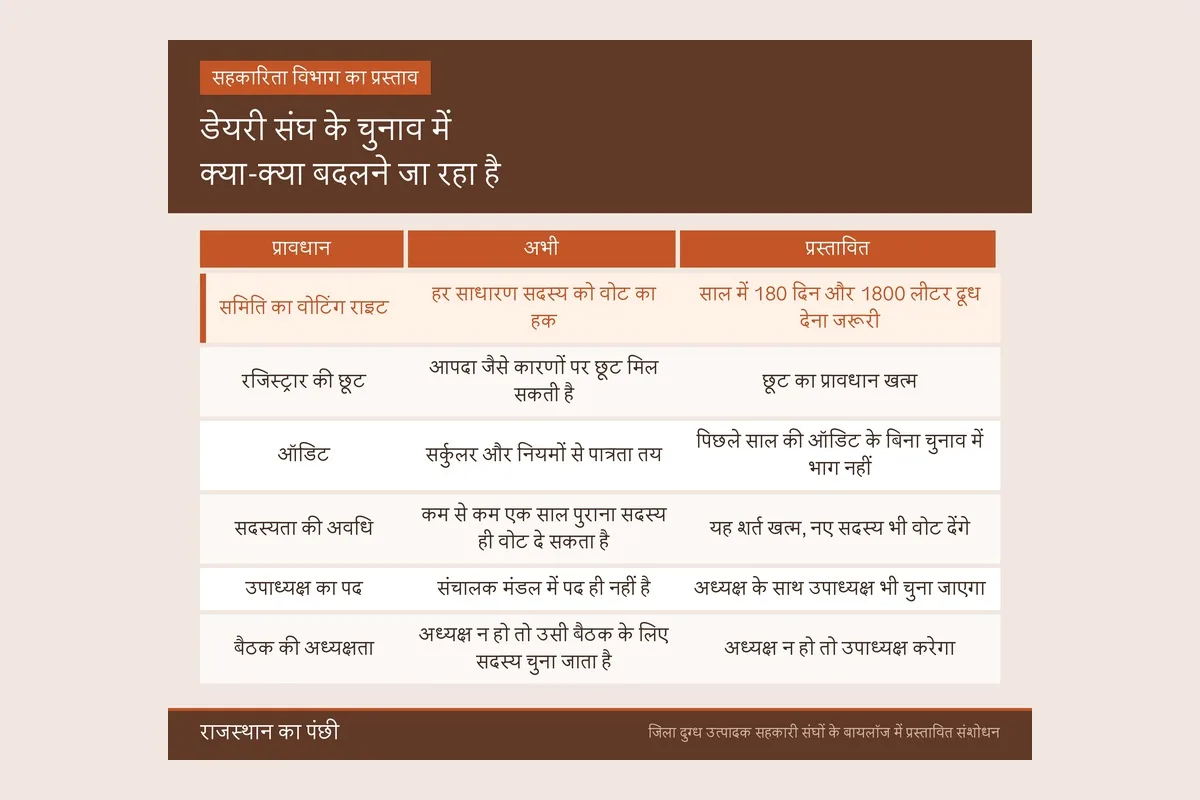
Jaipur, November 22: Significant changes are on the horizon for the elections of district dairy cooperative societies in Rajasthan. According to the proposed amendments, any committee that fails to supply at least 1,800 liters of milk for a minimum of 180 days in a year will lose its voting rights in the general assembly convened for the election of the board of directors. The Cooperative Department has initiated the amendment process under Section 11 of the Rajasthan Cooperative Societies Act, 2001.
The state has over 18,000 dairy cooperative societies, and this new requirement will directly impact them. With cooperative dairy elections expected next year, these changes are being implemented ahead of time.
No More Registrar Exemptions
Currently, committees that do not meet the milk supply threshold are ineligible to vote in board elections. However, if a committee is unable to supply due to natural disasters, the cooperative registrar can grant exemptions. This provision is being removed in the new proposal. The criteria for milk supply days and quantities will now be explicitly stated in the bylaws, requiring 180 days and 1,800 liters from the previous financial year.
No Participation Without Audit
Primary milk producer cooperative societies will only be allowed to participate in elections after completing their audits from the previous year. Currently, eligibility is determined by the registrar’s circulars and regulations.
Removal of One-Year Membership Requirement
This change will broaden the voting base rather than restrict it. Previously, only members who had been part of the society for at least one year on the election day could vote. The rule 20.1-3 is being abolished, allowing new members to vote as well.
New Vice President Role in the Board
Under the current rules, the board elects a president in its first meeting, with no vice president position. The new proposal will allow the election of a vice president alongside the president, whose term will match that of the board. In the president’s absence, the vice president will preside over meetings, whereas previously, a member was chosen for just that meeting.
Impact of the Changes
The Cooperative Department cites a Supreme Court ruling to justify these changes, although the specific case is not mentioned in the proposal. The practical effect will likely disenfranchise many individuals involved in dairy cooperative politics, particularly those with nominal societies that supply minimal milk. Candidates without adequate milk supply may also face challenges in contesting elections.
Dairy cooperative politics have historically reached the courts. In the Ajmer Dairy case, Ramchandra Chaudhary received relief from the High Court, preventing the dissolution of the board. Tensions have also persisted at the cooperative level, particularly regarding the appointment of the Managing Director in R.C.D.F. and outstanding dues of district dairy unions.
The government is also working on other levels of the dairy framework. Plans are in place to establish PACS and dairy societies as bank sakhi, and there is a push to elevate Sarso to a national brand.