
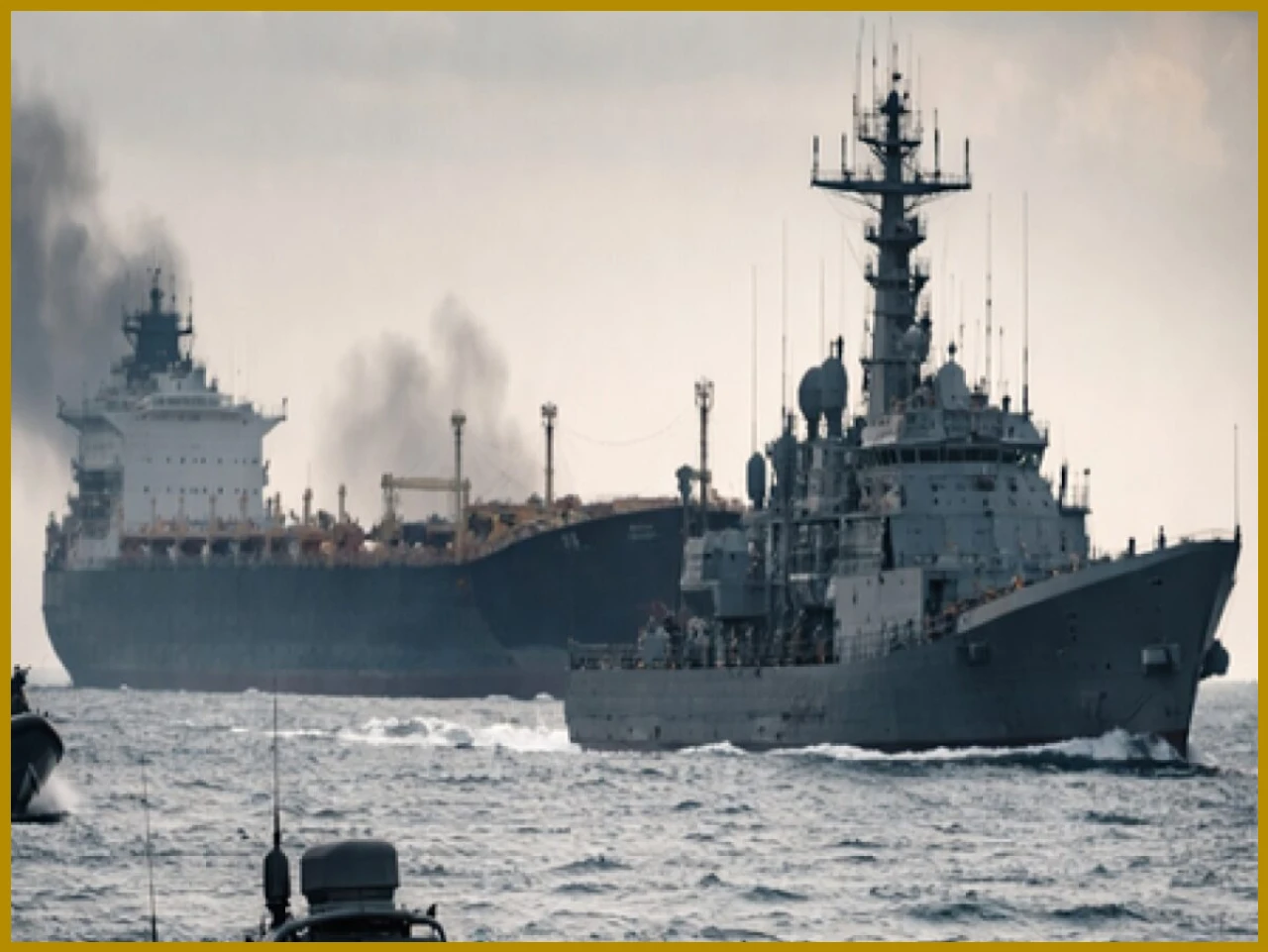
New Delhi, March 6: A maritime threat looms over the Gulf of Oman and the Strait of Hormuz due to escalating military tensions among Iran, the United States, and Israel. The situation has become increasingly unstable over the past 24 to 48 hours.
Several commercial vessels have been targeted by projectiles, missiles, and explosive attacks, effectively halting passage through this vital waterway.
Following U.S. and Israeli strikes on Iranian positions at the end of February, Iran has initiated retaliatory actions. Reports confirm multiple attacks on commercial ships since then.
At least three to eight commercial vessels, including oil tankers and a container ship, have been reported damaged. The assaults involved drone boats, missiles, and close-range explosions, resulting in at least one sailor’s death and several injuries.
The Strait of Hormuz is crucial, with approximately 20% of the world’s maritime oil and liquefied natural gas transported through it. Recently, only a few vessels have been sighted in the area, significantly below normal levels.
Hundreds of ships, including oil tankers and LNG carriers, remain either stranded in the waters or congregated in safe zones. Major shipping operators like Maersk and Hapag-Lloyd have completely halted transit through the Hormuz route. Some vessels are now being rerouted around the Cape of Good Hope, increasing both travel time and costs.
Compounding the risks, persistent GPS and AIS jamming is severely undermining navigation safety. Maritime intelligence firms have recorded over 1,100 instances of electronic interference on vessels in recent days, leading to false location displays for many ships.
Numerous war risk insurance providers have canceled coverage in Iranian waters, the Persian Gulf, and surrounding areas, making alternative measures costly and challenging for ship owners.
The Joint Maritime Information Center (JMIC) has raised the threat level in the region to critical, indicating that attacks are highly probable.
The U.S. MARAD advisory has urged vessels to avoid the area if possible, maintain a distance of 30 nautical miles from naval assets, and implement enhanced safety measures. Merchant ships are advised to exercise heightened vigilance, increase monitoring, cross-verify all navigation inputs (including radar and visual bearings), and strictly adhere to “Best Management Practices (BMP5 or MS)” security protocols while transiting or operating in the area.
Author Profile

- My name is Ganpat Singh Choughan. I am an experienced content writer with 7 years of expertise in the field. Currently, I contribute to Daily Kiran, creating engaging and informative content across a variety of categories including technology, health, travel, education, and automobiles. My goal is to deliver accurate, insightful, and captivating information through my words to help readers stay informed and empowered.
Latest entries
 PoliticsMay 13, 2026NEET-2026 Paper Leak Scandal Ignites Political Turmoil in Rajasthan
 UDAIPURMay 13, 2026Precision Medicine Will Shape Future Healthcare: Dr Kirti Jain
 UDAIPURMay 13, 2026Nurses Behind Every Patient’s Smile: Dr Kirti Jain
 HEADLINESMay 12, 2026NEET Paper Leak in Rajasthan Sparks Controversy: Ashok Gehlots Strong Critique of State Government