
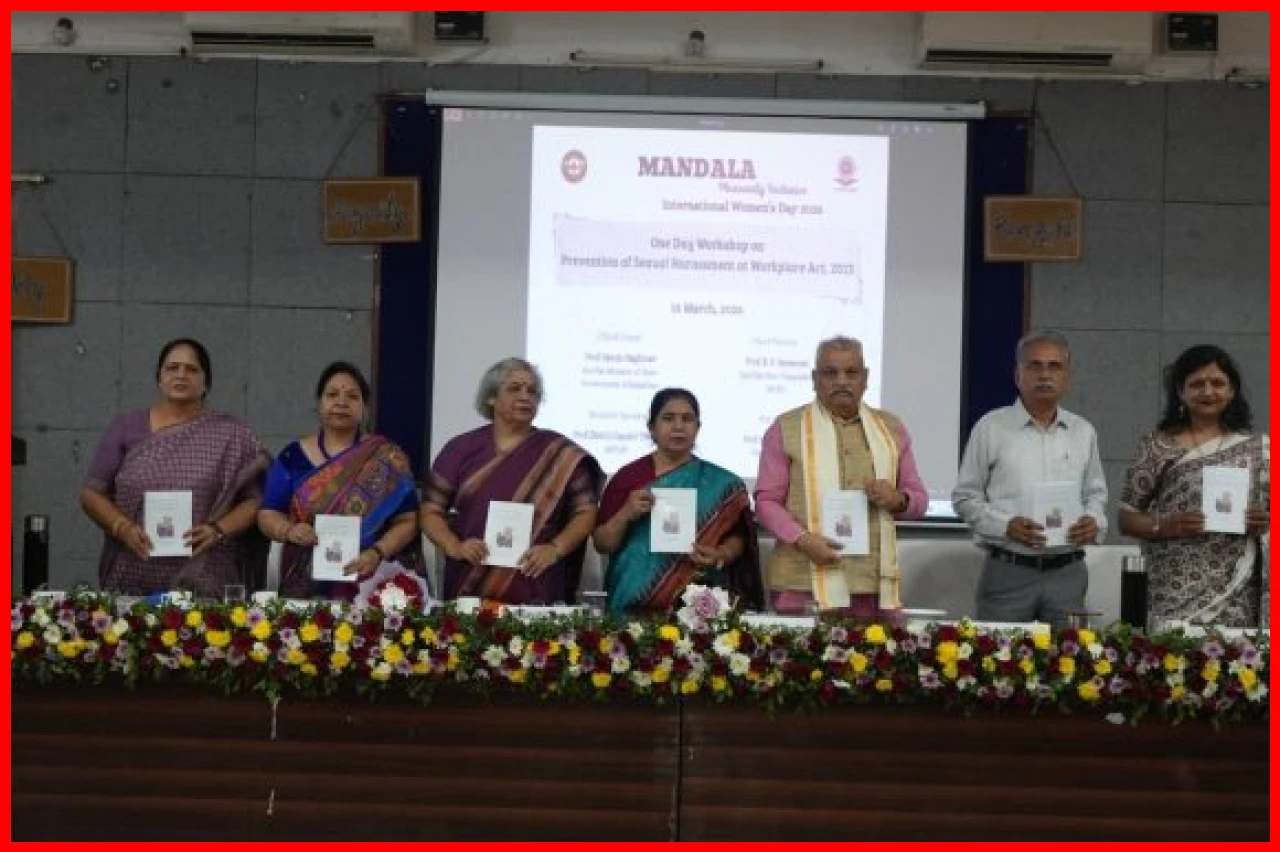
Udaipur, March 15: The fifth day of ‘Mandala 2026: Pleasantly Inclusive’ featured a workshop organized by the Women’s Studies Center at Mohanlal Sukhadia University. This event focused on the Prevention of Sexual Harassment of Women at Workplace (POSH) Act, 2013.
The workshop was a collaborative effort between Jatan Institute, Udaipur, and the Internal Complaints Committee (ICC) of Mohanlal Sukhadia University. Its primary goal was to discuss legal provisions, institutional responsibilities, and practical processes to ensure a safe, respectful, and inclusive work environment in the university and its affiliated colleges.
The chief guest was Professor Manju Bagmar, the State Minister for Women and Child Development in the Rajasthan government. She highlighted the necessity of the law and emphasized the importance of providing a safe environment for women, both at work and in public spaces.
The Vice-Chancellor urged female students and women to speak up immediately if they experience sexual harassment, stating that remaining silent only emboldens the perpetrator. He stressed the need for administrative determination to eliminate gender inequality. Professor Gayatri Tiwari, the keynote speaker, elaborated on preventing sexual harassment at the workplace, outlining key points related to judicial interpretations of the POSH Act and significant rulings from the High Court and Supreme Court.
The workshop, chaired by the Vice-Chancellor, also featured notable attendees such as Professor Sudha Chaudhary, Director of the Women’s Studies Center, and Professor Digvijay Bhatnagar, Coordinator of the ICC.
During the session, participants learned how to establish an Internal Complaints Committee (ICC) within any institution. The discussion included the structure of internal and external members, ensuring gender balance, and the importance of sensitivity and capacity-building training for committee members. Participants were informed that the ICC’s responsibilities extend beyond merely receiving complaints; they also include preventive measures, awareness programs, orientation, and creating a respectful workplace culture.
A special session was dedicated to the process of using the capable portal, detailing how institutions can register, fill annual compliance reports, and ensure adherence to the provisions of the POSH Act across all affiliated colleges. Participants were shown how to compile and upload data regarding complaints, awareness programs, ICC meetings, and training activities to maintain legal compliance and transparency.
Speakers emphasized the university administration’s responsibility to establish and activate the ICC in all faculties and affiliated colleges, ensuring regular reporting and reviews. It was suggested that each college regularly display information about the POSH Act through notice boards, website links, posters, handbooks, and awareness programs, so that students, faculty, and staff are well-informed about their rights and procedures.
On this occasion, a handbook prepared by the Women’s Studies Center on the POSH Act was also launched. Available in both Hindi and English, the handbook provides essential information, including the Act’s core provisions, definitions of sexual harassment, steps for filing complaints, the ICC’s procedural framework, FAQs, and useful resources, all presented in a concise and practical manner. The handbook, FAQs, and other essential information have been publicly uploaded on the university’s website for easy access by faculty, staff, and students of the university and its affiliated colleges.
During the Q&A and case study discussions, participants raised real-life scenarios, such as anonymous complaints, witness protection, provisions for false complaints, and the applicability of the POSH Act in online/hybrid workplaces. Experts provided detailed guidance on these issues. The organizers noted that this workshop, part of ‘Mandala 2026’, is a significant step towards strengthening a culture of gender justice, safety, and respect on campus, both constitutionally and behaviorally. A total of 140 teachers and students registered for the workshop.
Author Profile
- My name is Kuldeep Singh Chundawat. I am an experienced content writer with several years of expertise in the field. Currently, I contribute to Daily Kiran, creating engaging and informative content across a variety of categories including technology, health, travel, education, and automobiles. My goal is to deliver accurate, insightful, and captivating information through my words to help readers stay informed and empowered.
Latest entries
 UDAIPURMarch 15, 2026Workshop on POSH Act at MLSU Emphasizes Safe Workplaces
 UDAIPURMarch 14, 2026Progress Review of Aspirational Block Program Held by Central Officer
 UDAIPURMarch 14, 2026Crackdown on Illegal Drugs: Two Arrested Including Notorious Criminal
 UDAIPURMarch 14, 2026Progress Review of Sampoorna Abhiyan 2.0 in Kherwada