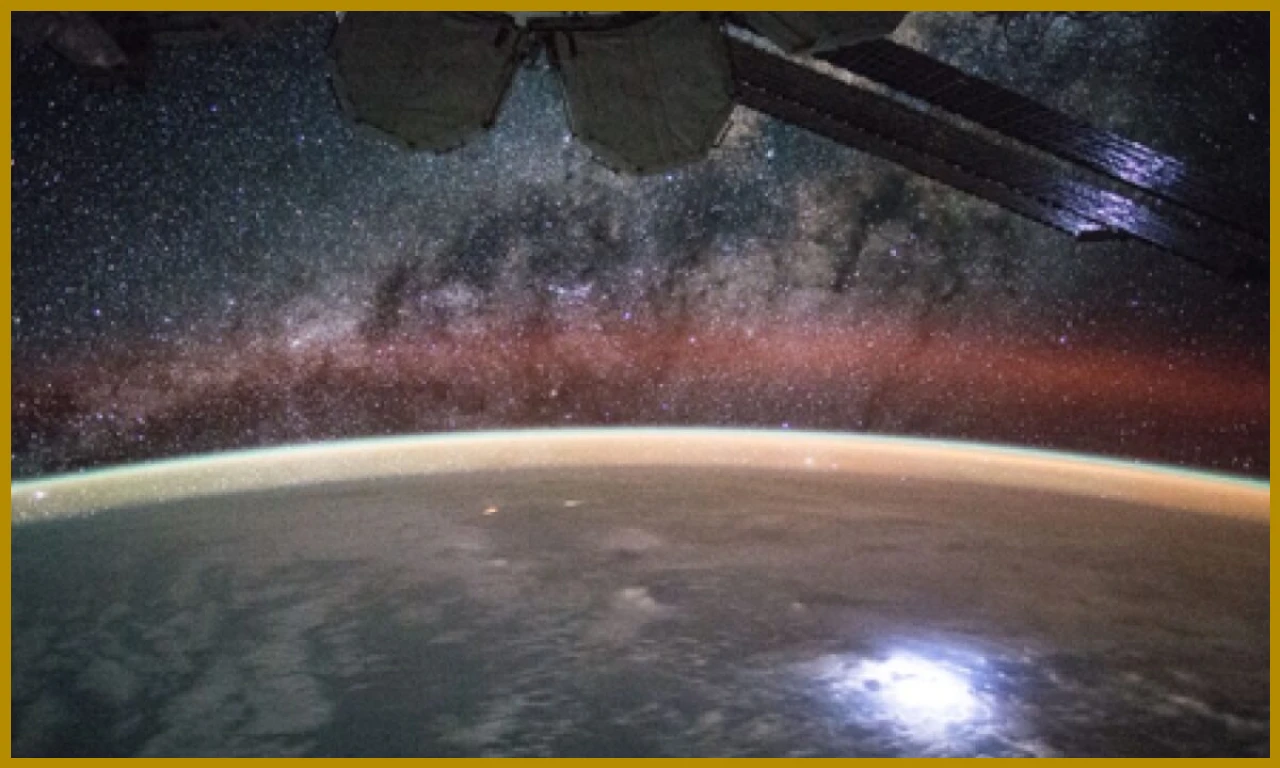
New Delhi, March 1: When we envision Earth from space, images of the “blue planet” often come to mind. However, a fascinating spectacle appears when viewed from the International Space Station (ISS), located in low Earth orbit. At an altitude of just 300 miles, the upper atmosphere reveals vibrant layers of red, green, purple, and yellow light. This phenomenon is known as ‘airglow.’ It represents Earth’s natural aura, preventing the night sky from becoming completely dark and showcasing the complex processes of our atmosphere.
According to NASA, airglow occurs when atoms and molecules in the upper atmosphere become more active due to sunlight. They release energy in the form of light, known as photons. This process is similar to auroras, but while auroras are created by high-energy particles from solar winds, airglow derives its energy from the sun’s regular light. Sometimes, ionized atoms also produce light by colliding with free electrons.
The night sky is never entirely black. Even when light pollution, moonlight, and stars are removed, a faint colorful glow remains, which is airglow. This glow accounts for about one-tenth of the total light from all stars. From space, it appears as a luminous bubble surrounding Earth, extending from 50 to 400 miles high, where the ionosphere is located. This region is crucial for GPS signals and is traversed by astronauts.
The colors of airglow originate from different gases. The brightest light, green, is produced by oxygen atoms. Red and other colors result from various reactions involving nitrogen and oxygen. Some colors exist in ultraviolet and infrared wavelengths, which are invisible to the naked eye. The thinness of the upper atmosphere allows atoms to remain excited longer without colliding, thus emitting light. In the denser lower atmosphere, collisions are more frequent, resulting in less light production. This glow constantly changes, influenced by both solar energy and Earth’s weather.
Airglow serves as a marker for changes in the ionosphere, similar to how smoke in the air indicates wind patterns. It provides information about temperature, density, and structure, aiding our understanding of the relationship between space weather and Earth’s climate.
Scientists are continuously studying this beautiful phenomenon as it is a vital means of understanding the connection between space and Earth’s weather. Images captured from the ISS clearly show these colorful bands, helping researchers monitor activities in the upper atmosphere.
Author Profile

- My name is Kuldeep Singh Chundawat. I am an experienced content writer with several years of expertise in the field. Currently, I contribute to Daily Kiran, creating engaging and informative content across a variety of categories including technology, health, travel, education, and automobiles. My goal is to deliver accurate, insightful, and captivating information through my words to help readers stay informed and empowered.
Latest entries
 UDAIPURMarch 24, 2026Voter List Draft Published in Udaipur Ahead of 2026 Municipal Elections
 UDAIPURMarch 24, 2026Mahi Dam Set to Become Eco-Tourism Hub with Master Plan for Hundred Islands Development
 UDAIPURMarch 24, 2026Rajasthans Tech Innovation Takes a Leap with the Unveiling of NIKKAI Humanoid Robot by Nimo Labs
 UDAIPURMarch 24, 2026Distribution of Assistive Devices for Differently Abled Individuals in Kherwara